
On a recent long run after a long bicycle ride on a very hot day, I had to stop multiple times to refill my little handheld water bottle. Over and over I had to stop and replenish my meagre supply. Anyone watching me would have thought what I was up to was mad, but to me, it was the feeling of being alive.
Reading The Sirens’ Call: How Attention Beams the World’s Most Endangered Resource. Chris Hayes. 2025, I found myself nodding away in agreement more often than not. The book discusses some issues we all face these days, but two in particular might be worthy of our attention as the summer comes to a close and schools prepare to welcome their students yet again.
First, the question of boredom. I remember being bored when I was a kid. We were so bored…in fact, I saw a comic joking about boredom these days being different. He describes, a kid watching tv while also scrolling on their phone—not entertained by either—complains of boredom, to which the comic says, “You are not bored, you are double not bored:)” Like the comic, I remember reading cereal boxes, being told to go outside and then spending hours wishing something, anything, would happen at our local park. The result of this was a lot of mayhem, you might call it kids being kids, but in my case it was a lot of trouble, much of which I regret. My childhood and teenage boredom lead to trouble created just so that there would be something rather than nothing. Thankfully, eventually, we “grow up” and find boredom less of a problem.
Hayes writes, “The reason we often associate boredom with childhood is that it is such an intolerable state that as soon as we’re old enough to wrestle autonomy away from our parents, we organize our lives to avoid it at all costs.”
The challenge of the mature is to find ways to do this that are productive, instead of creating trouble.
How much of what we do to avoid boredom actually costs us more than we care to admit to ourselves?
What costs do our families bear?
What about our bodies?
What ecological issues are arising on account of our need to be entertained?
What consolidation of wealth as our entertainers and that whole industry amass treasure while many struggle just to get by?
This summer, is there a way to be bored without causing harm? Hayes would argue that researchers know that we need to get bored, at least some of the time, and that our boredom-avoiding measures must be lighter than they generally are.
But boredom for boredom’s sake is, well, boring, and not too likely to be the goal for many of us.
In part, this is because of the second thought that jumped out at me from the book. Hayes describes what he calls The King’s Paradox: “never before in human life on the planet have more people had access to a wider array of diversions at each waking instant. And yet we are increasingly stalked, as the king is, by the sense that it’s not enough. The more diversion available, the more diversion we need, and the more intolerable we find its absence.”
Many of us are becoming more like hamsters on wheels than productive adults. We chase and chase, sometimes even forgetting what we are chasing. It hardly matters, so long as we are in motion, doing something, staying “busy.”
This is not new (remember Blaise Pascal wrote, “All of humanity’s problems stem from man’s inability to sit quietly in a room alone.” In the 1600s), but it may be more acute, and the “problems” are clearly getting more dramatic and consequential.
At the end of the summer, what we might need to realize is that the satisfaction, fulfillment, sense of contentment, we have all craved since childhood, cannot be found where the advertisers want us to think they will. They are not found in ways that make other people rich.
Maybe that is a rule: whatever makes someone else rich is not going to leave you fulfilled.
C.S. Lewis argued that our cravings hint at possibilities, that they tell us there is something on the other side, so just as hunger can be sated, so too can our sense of discontent.
Just as there is no “big broccoli” fighting for the elevation of everyone’s favourite vegetable, because there is no money in it, there is also no “big boredom.” Still, as with broccoli, we must give our minds a rest. So before this summer ends, why not engage in something quiet, still, or in motion, that doesn’t make anyone else any money, but revitalizes the soul?
What can do that for you?
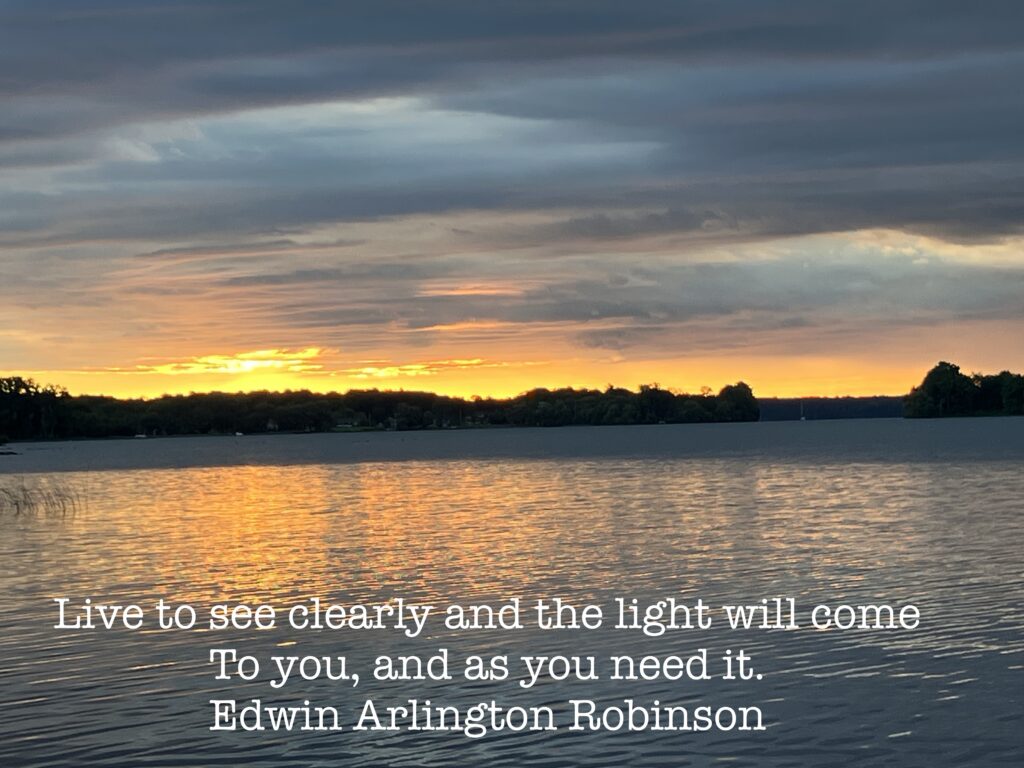
Looking at flowers, noticing clouds, holding hands, noticing the pause between your breaths, reading a library book, going for a walk, watching a sunrise or sunset (both get easier as August rolls in and days get shorter)…whatever it is, I suspect to others it looks boring because in my life the practices that work for this look terribly dull to the outside even if they are experienced by me like drinking from a well on a hot day.
Seek out that which looks boring to others, costs nothing (or nearly so), but which you experience with delight.
Do it before it is too late.
Leave a Reply