When I read A history of Canada in Ten Maps by Adam Shoalts, a book I really appreciated but was not sure how to write about, I thought that it contained snippets of a lot of stories that could be expanded upon and marvelled at the author’s restraint in not chasing down endless rabbit trails. It was good of him, the book could easily have become an unwieldy giant of a doorstop, rambling and losing the thread, and yet, so many stories were tantalizing. I struggle with this in sermons sometimes, letting a story go unsaid or an illustration unused because it is not quite right but at the same time I know it will entertain or delight in some way.
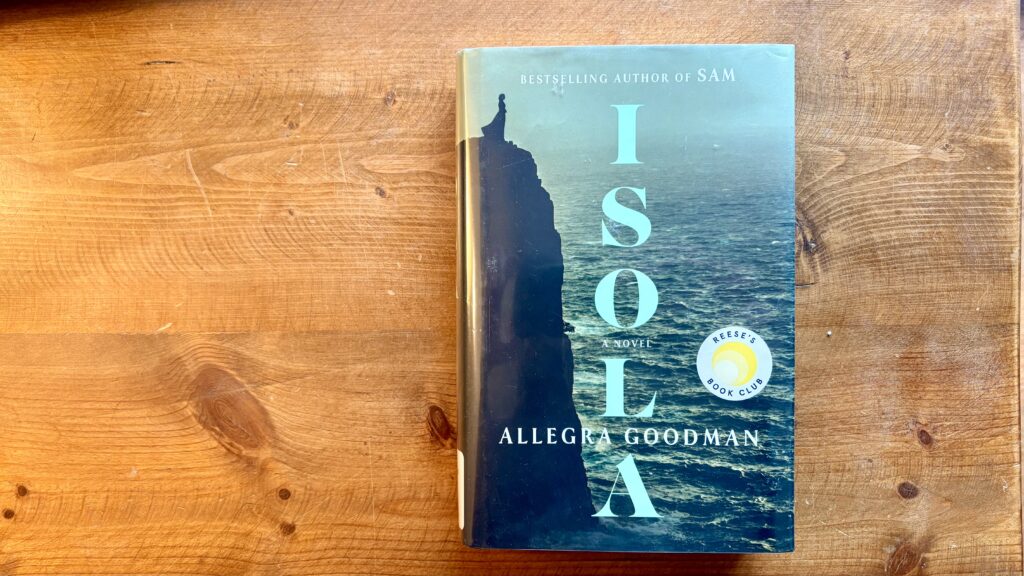
I was very surprised just a few days after reading that book to read a review in the newspaper of a book about a woman mentioned in the Maps book, a woman at the heart of one of the potentially ill-placed but interesting stories Shoalts could have run down in his book. It’s about a woman, Marguerite de la Rocque de Roberval, who really did accompany her kinsman Jean Francois on a 1542 journey to what was then New France. They had a serious falling out and she was left on an uninhabited small inhospitable island in the gulf of the St. Lawrence where she survived for two years before being saved by a passing boat. There are two main historical accounts of her story, they differ greatly (was she alone or with two others, was she saved by Roberval or Basque fishermen?), but either way this is wonderful fodder for a creative historical fiction writer.
Lucky for us, Allegra Goodman heard of the story and thought the same thing, and unlike me who cannot write a book, she can, and did!
Isola follows a version of events, I do not want to give too much away, wherein Marguerite is an orphan of means and a steward does her wrong in stomach churning ways. It highlights the plight of women in a society skewed towards the men, and balances that with a brave depiction of women using the power they did have, showing their resolve, their ingenuity, and their drive to survive as well. Marguerite may be born and raised something of a genteel woman, but she is not to be underestimated.
What really grabbed my attention in the book, beyond the basic travelogue adventure, was the use of the psalms in the tale. They are used for good and evil, they offer despair early on and hope later on. This is true in many lives of faith and in much that we might call “public christianity” today, it may be gentle and wise and compassionate, or it may be judgemental and belittling.
It reminded me of a debate I attended in seminary between a christian academic, a rabbi, and an atheist. Their topic was whether the bible is a tool of good or bad in the world. The Atheist used all the predictable arguments for the bible as evil. The Rabbi defended it as a tool of good highlighting God’s mercy and the importance of compassion. The Christian argued that it was more like any other tool, a hammer for instance could be used to build parts of the marvellous sanctuary we were in or it could be used to destroy a stained glass window out of an ugly hate, neither is really the fault of the hammer. The way Goodman handles the psalms and the life of faith in the book suggest she gets this deeply, and I appreciate her for that. It has been my experience that some ways of interpreting the bible are life-giving and expansive, and other ways constrain and often harm. This is not a reason to through it out, but a reason to handle it with care.
The psalms in Isola are wielded by a variety of characters for a variety of reasons, some good some evil. If for not other reason, many christians should want to read this book, to see the reality of this at play, and to imagine how it can work in our own lives.

Leave a Reply