As we enter lent I want to share a story and a practice that I have found helpful in my walk of faith, and for life in general. If you are considering dropping something this season, or taking something up, you could do worse than considering this:
I was in CEGEP (a Quebec schooling level) when I learned that people who managed to keep the same pen for a semester, writing all their notes with it and then their essay drafts and tests with it, did meaningfully better than those who changed pens more frequently. I don’t always pay close attention to studies, but let it not be said that I would miss such an earth-shattering but easy proposal. Keeping track of a pen is surely easier than anything else that can be asked of a student.
I am not too proud to admit that I am capable of laziness and this little life hack seemed too good to be true to a guy like me, so I bought a three pack of a pen that looked good, and cared for those pens like people used to care for their tamagotchis. I have no idea if my grades were better for it, they were never, shall we see, particularly impressive. Thinking back to my 18 year old self I probably slacked off a teensy bit more trusting in the study:).
Over the course of years I kept using the same pen strategy, it seemed to me that this involved an intentionality and personal organization that was new to me but helpful, like a ridiculously small keystone habit, that made me a better student in general.
Whatever the trick of the pens impact on my grades, that old pen study and my believing in it, made a lifelong scribbler of handwritten notes because long after computers had been the norm I was still writing notes on queue cards in preparation for the endless essays of my history degrees. Maybe it’s this analog element of my process that has kept me from becoming a professional historian, whatever that is.
Even now I go in and out of phases in sermon preparation where I fill notebook pages with an outline and quotes, ideas and illustrations, before I begin to type a sermon. There is something about pen to paper that I have always enjoyed, or maybe trained myself to. I also sometimes prepare blog posts on paper, and I always read a physical bible and journal in a physical notebook, a Leuchtturm 1917 if you must know (this is not a sponsored post, as George Mahood would say, other journals are available).
I have learned a lot about myself by journalling. I’ve come to conclusions I never otherwise would have by taking the time to reflect and ponder and capture. Relationships that matter to me have been seriously improved by this solo adventure as I scribble my way into realizations about my role in various situations and ways I might show love to specific people. All of which is to say journalling is great for the average person, not just Marcus Aurelius (other editions are available, though if you never read his notes you might want to).
Maybe the fact that journalling helps so many people is part of why there are so many known formats, there is one for every personality. If you tried one or two and it didn’t stick, consider trying another one and another until something does, because something will. My own practices have changed over time, what works at one point may or may not work forever, and also, some people need multiple journals, each with a purpose. There are no steadfast rules, there are no Journal Cops, so figure out what works for you and just do that.
Popular starters include:
- The “one line a day for five years” so you can note a single line about the day, and then each year for 5 years add a line, and review where you were or what you thought noteworthy that same day in previous years.
- For those who sit down and have no idea what to write/feel uncreative/are worried they are too boring, single sentence prompt journals, that have a sentence starter to get you going (like, what do I have now that I dreamed about having years ago?).
- Gratitude journals are popular and have a proven positive effect on our mental wellbeing, the practice here could not be simpler, everyday write 3-5 things you are grateful for, do not repeat them day by day, try to be as specific as possible.
- Some people like to journal about where they want to be in 5 years, others like to write about what happened today,
- “Morning pages” which are a three page brain dump to start the day.
- Common Place Book basically just a catch all for thoughts and quotes from other people that strike you as worth coming back to sometime.
Many scribblers include doodles, again they need not be “good” they need only help you express yourself and understand yourself better. Whatever works for you is great, so long as it works for you.

It may be helpful to remember that just as The ICE of Journals is not around in Canada, nor is there anyone else to read your stuff. It is freeing to write without any concern that someone else will read it.
This might be the hardest part: you need not edit yourself, but rather discover your truest self.
Think of those old diaries with a little lock, you have permission to write poorly (in penmanship and spelling and style), you can be raw, and vulnerable, open. Reject the editor in your mind, do not hold back, this is the route to greater self-awareness.
We can all agree that the world is full of people that could use more self-awareness. Just writing that I bet some people just came to mind for you. They come to mind because sometimes our lack of understanding has terrible consequences for us and those we love, or even for those we merely encounter in the day with road rage, or politicians losing sight of who they are or why they got into this anyways.
Let’s not be those people, let’s be thoughtful, self-aware, growing in understanding and depth. The world needs more such people and each of us can be one.
I find that trying to write daily-ish is best. My “daily” bible reading works this way too, I find annual plans that involve either 5 or 6 days a week so that if I miss a day it is no big deal (and when I get ahead, by actually doing it every day, I am excited). This is a gentle element that can make journalling more approachable. Mostly, I find I rarely miss a day because it is a practice I enjoy and when I miss it early in the day I miss it in a different way later in the day too.
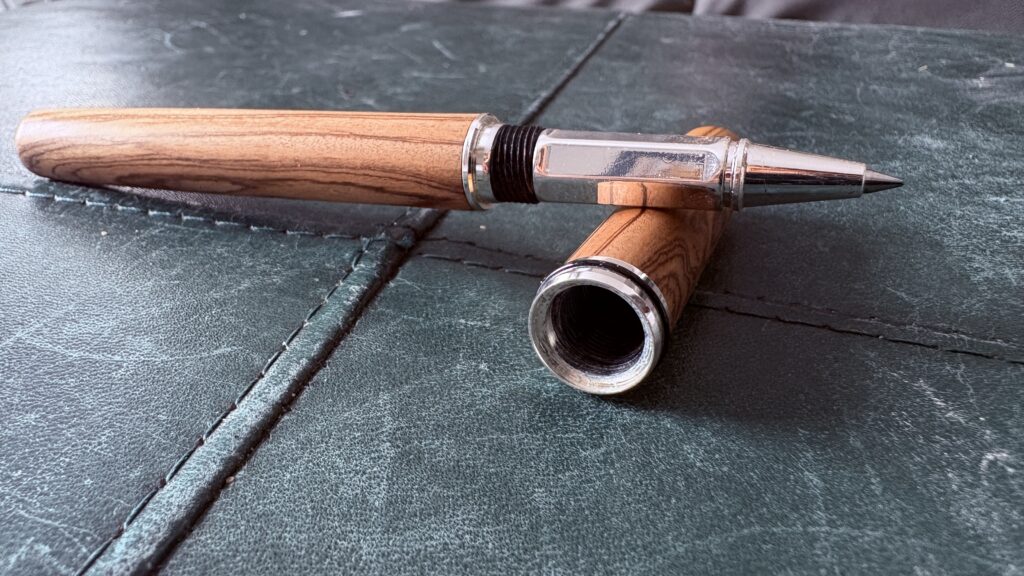
One need not be wealthy to do this, you need only five or ten quiet minutes and a pen and paper. Of course, you can spruce it up with a bespoke ceramic mug holding the finest tea or coffee, a swell pen (mine is made by a minister friend of mine out of olive wood from Jerusalem, which is not important but delights me), a fancy journal with creamy paper…but really, any paper and writing tools that inspires you will suffice.
So there it is, my encouragement to you to get journalling, whatever that looks like for you. Grab whatever implements will work near you now and give it a go, write a whole page about how you do not have time for this and journaling is stupid anyways, that’s fine, as long as you start writing.

Leave a Reply